


ChessBase 17 - Mega package - Edition 2024
It is the program of choice for anyone who loves the game and wants to know more about it. Start your personal success story with ChessBase and enjoy the game even more.

According to David Jarrett, executive director of the World Chess Federation, women make up about 10% of the organization's estimated one million members, 7.6% of 100,456 rated players, and 2% of the top 1,000 players world-wide. More significantly, the caliber of the top female players is rising. In July 2005, grandmaster Judit Polgar, Susan's youngest sister, was the eighth-ranked player world-wide. And prominent chess coaches predict that the number of women holding active grandmaster status—now 18 out of 1,028—will triple within five years.
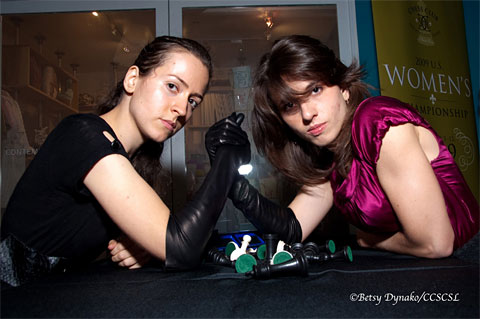
IM and WGM Irina Krush, 25, rated 2478, and WIM Iryna Zenyuk, 23, rated 2281
arm wrestle at the 2009 US Women's Championship in Saint Louis
Yet the federation, known colloquially as FIDE (pronounced fee-day), persists in the anachronistic and demeaning practice of awarding separate titles for women at lower levels of accomplishment. For example, to qualify as a grandmaster (GM) today, men and women must earn two or more "norms" (prespecified favorable results in qualifying tournaments) at a performance rating of 2600 and achieve a published overall rating (a system ranking relative player strength) of 2500. But female players attain the woman grandmaster (WGM) designation by earning two or more norms at a performance rating of 2400 and achieving published ratings of 2300. So it's easier to attain the WGM title than to become an international master (IM), which requires two or more norms at 2450 and an overall rating of 2400.
The time has come to drop gender-segregated titles for women, which make even less sense today than when they were introduced in 1950 (WIM) and 1976 (WGM). "I don't see their benefit," says 25-year-old IM Irina Krush. "Women's titles are really a marker of lower expectations." Ms. Krush, part of the bronze-medal-winning American women's team at the 2008 Chess Olympiad in Dresden, tied for third place with 18-year-old rising star Alisa Melekhina in the U.S. Women's Championship, which concluded yesterday at the Chess Club and Scholastic Center of St. Louis. Top-seeded IM Anna Zatonskih, 31, won first prize.
Read the full WSJ article here – and tell us what you think (subject: "Women's titles")