

ChessBase 17 - Mega package - Edition 2024
It is the program of choice for anyone who loves the game and wants to know more about it. Start your personal success story with ChessBase and enjoy the game even more.
The World Economic Forum (WEF) is a Geneva-based non-profit foundation best known for its annual meeting in Davos, Switzerland which brings together top business leaders, international political leaders, selected intellectuals and journalists to discuss the most pressing issues facing the world including health and the environment. The Forum also organizes the "Annual Meeting of the New Champions" in China and a series of regional meetings throughout the year. In 2008 those regional meetings included meetings on Europe and Central Asia, East Asia, the Russia CEO Roundtable, Africa, the Middle East, and the World Economic Forum on Latin America.
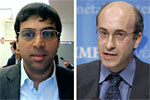
World Champion Viswanathan Anand gives his impressions in Davos
By far the chirpiest gathering I attended in Davos was on my last night at a private dinner populated largely by top Indian journalists, senior policymakers, and leading Indian businesspeople. Of course, people were very excited about the academy award nominations for “Slumdog Millionaire,” not to mention the stellar presence at Davos of World Chess champion Vishy Anand (who recently defeated Russia’s Vladimir Kramnik to cement his title).
But the real reason my Indian companions were so cheerful was a strong sense of relief that they were living far from the epicenter of the recession, insulated by their country’s size and still-comparatively stringent restrictions on international capital flows. “Thank heavens for the strong regulatory framework we have in our financial system,” one leading provider of soft consumer goods said.
Read the rest in the New York Times Davos Diary.
If there is one overarching theme to virtually all my private conversations at Davos this year, it is the credit drought. Small and medium size businesses across all types of industries claim they cannot get credit. Small and medium size counties can get credit but suddenly the risk spreads they are paying are soaring. Even many CEOs from large firms say that while they can still raise money in a variety of ways – bank loans, corporate bonds and equity markets – the cost is soaring and the conditions have tightened dramatically. The head of a large bank that thinks it is still solvent (I wonder if saying that gives away their identity?) says its managers don’t know how much they can lend because it is obvious they are about to face a brave new world in terms of the regulatory environment. (While reviews of the Obama economic team remain glowing, there is notable discomfort here in Davos that the new administration has not yet announced its big bang plan for the financial system.)
Read the rest in the New York Times Davos Diary (with video report).
Perhaps the Obama administration will be able to bring a surprisingly early end to the ongoing U.S. financial crisis. We hope so, but it is not going to be easy. Until now, the U.S. economy has been driving straight down the tracks of past severe financial crises, at least according to a variety of standard macroeconomic indicators we evaluated in a study for the National Bureau of Economic Research (NBER) last December.
In particular, when one compares the U.S. crisis to serious financial crises in developed countries (e.g., Spain 1977, Norway 1987, Finland 1991, Sweden 1991, and Japan 1992), or even to banking crises in major emerging-market economies, the parallels are nothing short of stunning.
Read the rest in the Wall Street Journal.
The creation of a government bad bank to buy toxic assets is necessary, but then the government will need to take control of and restructure major banks to fix the system, one economist at the World Economic Forum in Davos told CNBC.com. "They have to do a bad bank," Harvard Economics Professor Ken Rogoff said. But "if that's all they do then it's idiotic." Institutions like Citi and Bank of America will have to go, boards will have to be fired and equity stakeholders will be wiped out, Rogoff said.
The plan could mirror the one Sweden implemented, where all troubled banks were nationalized, their balance sheets were cleaned up and the good parts of the businesses were sold to the private sector. That solution was "much cleaner," he said. Sweden’s banks were effectively bankrupt in the early 1990s, but the government pulled off a rapid recovery that actually helped taxpayers make money in the long run. The government placed banks with troubled assets into a so-called bad bank, where they could be held and then sold when market and economic conditions improved.
Read the rest in CNBC (with video report).
Kenneth Rogoff is Thomas D. Cabot Professor of Public Policy and Professor of Economics at Harvard University. From 2001-2003, he served as Chief Economist and Director of Research at the International Monetary Fund. He is also a former Director of the Center for International Development at Harvard. Rogoff’s research covers global economic issues, including exchange rates, international capital flows and monetary policy. His treatise Foundations of International Macroeconomics (joint with Maurice Obstfeld) is the standard graduate text in the field worldwide, and his monthly syndicated column on global economic issues is published in 13 languages in over 50 countries. Rogoff is on the Economic Advisory Panel of the Federal Reserve Bank of New York and the Central Bank of Sweden. He is currently writing a book (with Carmen Reinhart) on the history of international financial crises over nine centuries.
Rogoff is an elected member of the American Academy of Arts and Sciences, as well as a member of the Council on Foreign Relations, the Trilateral Commission and the Group of Thirty. He is also a fellow of the Econometric Society and the World Economic Forum, and has been invited to give numerous named campus-wide lectures at universities around the world. He holds the life title of international grandmaster of chess, and at his peak was ranked number 40 in the world.
More detailed biographical information including full cv and editorial writings can be found here. More about Ken, who recently visited us in Hamburg, in a future article.