
ChessBase 17 - Mega package - Edition 2024
It is the program of choice for anyone who loves the game and wants to know more about it. Start your personal success story with ChessBase and enjoy the game even more.
|
|
||||||||||||||||||||||||||||||||
|
|||||||||||||||||||||||||||||||||
GM Group A

GM Group B
GM Group C
One of the most eternal debates in chess is over so-called "Grandmaster draws". The right of two players to agree a draw at any moment in the game causes considerable distress to many spectators, and especially to sponsors. All manner of ideas have been suggested to deal with this problem, with the simple banning of draw offers in less than 40 or 50 moves being the most common nowadays. But even that does not stop the players engineering a threefold repetition. I have no desire to get involved in the debates about the rights and wrongs of draws, but one point seems to have escaped attention, as far as repetitions are concerned. The oriental game of Go has a similar problem, with what are called Ko positions. This is a repetition situation, where White plays a stone on a certain point, and captures a black stone, and Black could then play on the adjacent point, capturing the white stone, and repeating the initial position. Without something to prevent it, many games of Go would end in early draws due to this repetition.
|
The ko rule (from the Japanese 劫 kō "eon"), prevents unending repetition. Black has just played the stone marked 1, capturing a white stone at the intersection marked with a circle. If White were now allowed to play on the marked intersection, that move would capture the black stone marked 1 and recreate the situation before Black made the move marked 1. Allowing this would result in an unending cycle of captures by both players. The ko rule therefore prohibits White from playing at the marked intersection immediately. Instead White must play elsewhere. See Wikipedia on Go. |
The rules of Go deal with the repetition issue very elegantly, by providing that after one player has captured in a Ko situation, the second player is not allowed to play his next stone into the Ko. Instead, he must make a move elsewhere on the board. In principle, this allows the first player to fill in the Ko, and end the possible repetition. However, if the second player manages to find a move elsewhere on the board, which creates a serious threat, the first player has no time to fill in the KO, and must attend to the threat. Once he has done so, the second player can retake the Ko. Now the boot is on the other foot – the first player must find a threat elsewhere on the board, which is sufficiently strong to force the second player to attend to it, whereupon the first player retakes the Ko. And so it goes on, with the players exchanging Ko threats, and alternately retaking the Ko. Eventually, one player runs out of threats, is forced to play an inoffensive move elsewhere on the board, and the opponent fills in the Ko once and for all.
The effect of this is that what would otherwise be the cause of many premature draws becomes a great element of skill. The ability to gauge in advance who has the greater number of effective Ko threats, and therefore who will ultimately win the Ko fight, is frequently the key to determining the outcome of the game. I once saw a classic game involving Go Seigen, one of the greatest of all Go players, in which a Ko fight extended for over 40 moves of mutual threats and counter-threats. Eventually, Seigen emerged victorious, and by taking the Ko, achieved a decisive advantage in the game. It would be most interesting to experiment with a similar rule in chess. I am far from sure it could be made to work effectively in our game, but it may be worth thinking about it. I believe some similar prohibition on repetitions applies in Shogi, although not having played that game, I am not sure of the details. In any event, it seems that we players of the Royal Game may be able to learn something from our gaming siblings, and perhaps the time has come to consider this.
These thoughts about draws in chess were prompted partly by events in today's game between Kariakin and Aronian. Sadly, it was the sort of game that opens up the debate about short draws. The players repeated 18 moves of Anti-Marshall theory, then shook hands, just 30 minutes after the start of the round.
Karjakin,Sergey (2706) - Aronian,L (2750) [C88]
Corus A Wijk aan Zee NED (7), 24.01.2009
Notes by Sergey Shipov, translation by Steve Giddins
1.e4 e5 2.Nf3 Nc6 3.Bb5 a6 4.Ba4 Nf6 5.0–0 Be7 6.Re1 b5 7.Bb3 0–0 8.h3. No Marshall. Kariakin prefers to avoid a theoretical duel and saves his novelties for another day. 8...Bb7. Nowadays, Black leaves the pawn on d7 a little longer. Maybe he can still play d5 in one move, and also the bishop retains the chance to come to c5. 9.d3 d5. See the previous note. Black is ready to part with a pawn. 10.exd5 Nxd5 11.a4. White plays it safe. The point is that after 11.Nxe5 Nd4! Black manages to exchange off the powerful Spanish bishop.11...Nd4 12.Nxd4 exd4 13.axb5. The speed of play suggests that both players were prepared for exactly this variation. 13...axb5 14.Rxa8 Bxa8 15.Na3. I have seen this position before. Yes, now I remember! It was in December, at the Grand Prix in Elista, the game Leko-Jakovenko. White quickly achieved a decisive advantage, but could not win. Peter's team was very upset, and Dima was delighted... 15...Bb4. Virtually the only sensible move. If 15...Qd7 16.Qg4! is very strong.; and after 15...Bxa3 16.bxa3 c5 17.Qg4 White's two bishops give him a strong initiative.; 15...b4 is just positionally bad. 16.Bd2. In the above-mentioned game, the players first repeated moves: 16.Re5 Bd6 17.Re1 Bb4 and only then was 18.Bd2 played. 16...Bxd2 17.Qxd2
17...Qf6. Novelty! The Leko-Jakovenko game went 17...Bc6? 18.Re5! b4 19.Nb5! Nf6 20.Qf4 Bd5 21.Bxd5 Nxd5 22.Qxd4 c6 23.Na7! Qc7 24.Nxc6 Qxc6 25.Rxd5 Qxc2 26.Qxb4 and, believe it or not, the Hungarian no. 1 and Super-GM could not realize the advantage of two extra pawns. I remember we analysed the text in the press-centre at Elista, and we humans could not find any advantage for White. Now we will see what Kariakin and his computer have come up with. Black offers the b5-pawn,but prepares the powerful Nd5-f4. After 18.Nxb5 there is 18...Nf4 19.f3 Qh6 20.Kh2 (20.Qf2 Qg5!) 20...Bxf3 21.gxf3 Qxh3+ 22.Kg1 Qg3+ and Black has at least a draw. Probably a draw at most, as well. 18.Bxd5 DRAW! A cynical decision, in my view. No fight at all took place here. Poor show, Sergey. Poor show, Levon. [Click to replay]
Adams-Radjabov was also a short draw, after the former's quiet treatment of the Sicilian produced no advantage. With his first choice game having finished so quickly, our tireless commentator Sergey Shipov switched his attention to the encounter between Morozevich and Smeets, which was to prove a tragedy for the Dutchman.
Morozevich,A (2771) - Smeets,J (2601) [D11]
Corus A Wijk aan Zee NED (7), 24.01.2009
Notes by Sergey Shipov, translation by Steve Giddins
1.d4 d5 2.c4 c6 3.Nf3 Nf6 4.e3. I like Sasha's caution! Yesterday, he played too adventurously, even recklessly, and paid the price. Today, it seems, he has taken himself in hand and is playing solidly. 4...Bg4 5.Qb3. A slight side-step, looking to avoid well-known paths as soon as possible. Sasha wants to avoid a memory test, and just play chess. 5...Qb6 6.Nc3. It is not in either side's interest to exchange queens at present, as this would improve the opponent's pawn structure. 6...e6 7.Nh4. Going after Black's light-squared bishop. 7...Bh5 8.h3 g5. A very sharp move! The game Carlsen-Movsesian, earlier this week, continued 8...Nbd7 9.g4 Bg6 10.g5 Ng8 11.Nxg6 hxg6 12.Qc2 Ne7 13.Bd2 Nf5 14.cxd5 cxd5 15.Nb5 Bd6 16.Qa4 a6 17.Rc1 Ke7 18.Nxd6 Nxd6 and Black, rather surprisingly, demonstrated that the two knights can fight successfully against White's two bishops. 9.Nf3. Again played quietly. The game Gonzales-Savchenko, Palma 2008, went 9.g4 gxh4 10.gxh5 Rg8 11.Be2 Nbd7 12.Bd2 Qc7 13.cxd5 exd5 14.Rc1 Nb6 15.Qc2 Qe7 16.b4 Qe6 17.b5 c5 18.Kf1 Nc4 and Black eventually won a sharp game. 9...h6 10.g4. Sasha lurches forward. One cannot forever restrain one's temperament. The source game continued 10.Ne5 Nfd7 11.Nd3 Bg6 12.Bd2 Na6 13.Rc1 Qxb3 14.axb3 Nb4 15.Nxb4 Bxb4 16.h4 0–0 17.cxd5 exd5 18.Be2 a6 and Black had no problems. Wang Yue - Aronian, Dresden 2008. 10...Bg6 11.h4. Attack at all costs! Frankly, though, it seems to me that this move leads only to numerous exchanges and a draw. But let us see. 11...Qxb3. A small concession. However, after 11...Nxg4 12.hxg5 Na6 White can force the queen exchange by 13.c5! 12.axb3 Rg8. Smeets believes his opponent. After 12...Nxg4 13.hxg5 White has the cunning idea of trapping the knight on g4 by means of Nf3-g1 and f2-f3, eg 13...Na6 14.c5 Nb4 15.Ra4 Nd3+? (But stronger is 15...a5 though here Black has to calculate a long forced variation: 16.Ng1 Bd3! 17.f3 Nc2+ 18.Kd2 Bxf1 19.Kxc2 Nf2! 20.Rh2 Nd3! 21.Bd2 Nb4+ and the king's knight escapes to the queenside! ) 16.Bxd3 Bxd3 17.Ng1! and White emerges with an extra piece. 13.hxg5 hxg5. Now the mutual capture of the g-pawns will just lead to equality. But Sasha is spending time, looking for something better. 14.c5. A sensible reaction. White intends b4-b5, with strong pressure on the queenside. Smeets' exaggerated respect for his opponent may turn out badly for him. 14.Nxg5 Bc2! is not dangerous for Black.; It is tempting to examine 14.Ne5 Bc2 15.c5 but it is very hard to analyse to the end the daring capture 15...Bxb3!? After 16.Bd3 the black bishop is in trouble, but he can play 16...Nbd7 17.Ra3 Nxe5 18.dxe5 Nd7 19.Rxb3 Nxc5 20.Bc2 Nxb3 21.Bxb3 and I am not sure how to evaluate this unusual position. Probably, Black is OK.
14...Nxg4. I don't see any alternative. Black cannot hold up the queenside advance: 14...Nbd7 15.b4 a6 16.b5! 15.b4. Morozevich rushes it! he does not believe it necessary to regain the pawn. I am not sure that his compensation is so significant, however. It seems to me that the simple line is more promising: 15.Nxg5 Bc2 16.Nf3 Bxb3 17.Bd3 17...Nd7 (Looking deeper, I found an improvement for Black:17...Na6 and the threat of the knight jump to b4 forces White to part with one of his bishops. 18.Bxa6 bxa6 19.Rxa6 Kd7 20.Rg1 f6 and it is difficult to find resources for White to develop his initiative.) 18.Nd2 Bc4 19.Nxc4 dxc4 20.Bxc4 and White has a clear advantage, thanks to his two bishops and superiority in the centre. 15...f6. Agreed! A good reply. By defending his pawn on g5, Black enables the knight to return via h6. [After 15...Be7 the knight would be stuck on g4 for a long time. 16.b5. An important moment. How should Black meet his opponent's queenside attack? He has no time to waste. If the second white b-pawn reaches b5, White will have a large advantage. Black needs to meet this by playing a6, cxb5, and putting a knight on c6 and his king on d7. I do not see any other way. 16...cxb5. The same idea, but in a less convincing form. I was looking at 16...a6! 17.b4 cxb5 18.Bxb5+ (18.Nxb5 Kd7) 18...Nc6 and did not find anything special for White. 17.Rg1. After 17.Bxb5+ Nc6 the striking 18.Ra6 does not bring anything after 18...0–0–0! 17...Nh6. Played carefully. Also not bad is 17...Bf5; and even 17...Bh5 but approaching time-trouble makes Black hurry things. 18.Nxb5 Kd7 19.Rxa7. He has to recapture the pawn. 19...Rxa7 20.Nxa7 Nc6 21.Nxc6. Too slow is 21.Nb5 Nb4! 21...bxc6. Each side's weaknesses roughly cancel each other out. 22.b4. White has a pawn majority on the queenside. But at present, the infantry lack artillery support, and by themselves they cannot win the battle. 22...Be7. Played after quite long thought. I believe the position is about equal and a repetition may be forced. A depressing prospect for the Muscovite! He ahs too few points, and is much the higher-rated player...But I fear that Sasha may overdo things in trying to avoid a draw. My analysis managed to cast doubts on the alternative 22...Bg7 23.b5 cxb5 24.Bxb5+ Kc7 25.Bd2 Ra8 26.Nxg5! Ra1+ 27.Ke2 Rxg1 28.Nxe6+ Kc8 29.Nxg7 and White's two pawns are worth more than Black's extra exchange. 23.Kd2. Here is the line which leads to an early dinner: 23.b5 cxb5 24.Bxb5+ Kc7 25.Bd2 Ra8 26.Ke2 Ra2 27.Rh1 Ng4 28.Rh8 e5 (28...Be4 29.Re8!) 29.Rg8 Bh5 30.Rh8 Bg6 31.Rg8 etc. 23...Be4. The rook penetration does not lead to success: 23...Ra8 24.Bb2 Ra2?! 25.Kc3! 24.Ne1. An equal ending results from 24.Be2 g4 25.Nh2 f5 26.f3. 24...g4! Black successfully exploits White's slowness. 25.Kc3? But this is dubious, if not downright bad. Morozevich should have maintained equality by 25.Be2 f5 26.f3. 25...f5. The bishop comes to h4 and Black develops strong pressure. 26.Nd3?! Continuing to drift. He should defend by 26.Be2 Bh4 27.Rf1 so as to put the king on b3 and play f2-f3. 26...Bh4! The f2 pawn is on the verge of extinction. White now needs study-like accuracy to save the game. Clearly, he needs to find a way to sacrifice the f2 pawn and create piece counterplay. In time-trouble this is the best chance. Clock times are 0.22–0.14. 27.f4? Seemingly another oversight. More stubborn was 27.Ne5+ Kc7 28.Bg2! Bxf2 29.Rh1 Rh8 30.Bxe4 dxe4 31.Ng6 g3! (31...Rh7 32.Nf8 Rh8 33.Ng6 =) 32.Nxh8 g2 33.Rd1 Ng4 34.Ng6 Black has the initiative, but I cannot see a clear win. White seems to have time to win the e6 pawn with his knight. 27...gxf3. I think Black would retain a serious advantage by keeping the pawn on g4. But taking on f3 is even stronger. 28.Rh1. 28.Ne5+ Kc7 29.Rh1 f2! 30.Rxh4 Rg1
28...Bg5? Jan is getting nervous! [He could secure a decisive advantage by 28...Nf7! 29.Rxh4 Rg1. 29.Ne5+ Kc7. Times:0.16 - 0.06. There are still many moves to make to the time control, and so, many chances to go wrong. 30.Rh3 Ra8? Correct was 30...f2! 31.Rh2 Bf6! 32.Rxf2 Bxe5 33.dxe5 Rg1 and White will lose the e5 pawn, since after 34.Rf4 Ng4 35.Kd4? Nh2! he loses a piece. 31.Nxf3 Bxf3 32.Rxf3. Now the worst is behind White. 32...Ra2. Black retains some slight pressure, but nothing too serious. 33.Rh3 Accurately played. Trying to take the initiative by 33.Rg3 Ng4 34.Bh3 rebounds: 34...Bh4! 35.Rg1 Bf2 36.Rg2 Nxe3! 37.Rxf2 (37.Bxe3 Ra3+!) 37...Rxf2 38.Bxe3 Rf3. 33...Ng4 34.b5. Morozevich returns to the right idea. Passive defence of e3 could lead to new problems. 34...cxb5 35.Bxb5 Rh2. In serious time-trouble, Jan hurries to simplify. Stronger was 35...Bh6. 36.Rxh2 Nxh2 37.Kd3. The initiative has passed to White. 37...Ng4 38.Bd2. The bishops are ready to drive off the black kin and support their passed pawn. 38...Bh4. An accurate manoeuvre. From g3, the bishop will cover the crucial c7 square. 39.Ba5+ Kc8 40.Be8. There was no win by 40.Ba6+ Kb8 41.c6 Bg3! 40...Nf6. A further inaccuracy. Better was 40...Bd8! 41.Be1 Nf6 and now 42.Bf7 is ineffective because of 42...Kd7 But only those who have never been in his situation could criticise the Dutch player - after time-trouble ends, one's hands are shaking and one's head is spinning. 41.Bf7. Now Black is losing a pawn. 41...Kd7 42.c6+ Kxc6 43.Bxe6. F5 must drop. A new phase of the battle is beginning. With two bishops and an extra pawn, White ahs winning chances, at least in practice. It is certainly the best position Morozevich has had in the whole game. 43...Ne4 44.Bxf5 Nd6. A good set-up. Black sits tight and waits for White to attempt something. 45.Bg4 Nc4 46.Bc3 Nd6. It seems he can draw by 46...Bf2 47.e4 Ne3! but the resulting variations are too difficult for a tired player to work out. 47.Bf3 Bf2 48.Bd2
48...Nc4? The last tragic oversight in this game. By simply moving his bishop to and fro, Black can hold. 49.Bxd5+! and if 49...Kxd5 50.e4+, winning a pawn and the game. 1-0. One can only sympathise with Smeets, whose nerves failed him. [Click to replay]
Dominguez-Wang Yue saw the Berlin Wall uphold its solid reputation, while Movsesian had another great result, downing Ivanchuk with the black pieces. In a Scheveningen Sicilian, the Ukrainian lost control in the middlegame, and Black's e and f-pawn couplet sliced through the white position like the proverbial hot knife through butter.
Ivanchuk,V (2779) - Movsesian,S (2751) [B80]
Corus A Wijk aan Zee NED (7), 24.01.2009
1.e4 c5 2.Nf3 d6 3.d4 cxd4 4.Nxd4 Nf6 5.Nc3 e6 6.Be3 Nc6 7.f4 Bd7 8.Be2 Be7
9.Ndb5 Qb8 10.a4 0–0 11.0–0 Rd8 12.Kh1 Nb4 13.Bf3 e5 14.Qe2 Bc6 15.fxe5 dxe5
16.a5 b6 17.axb6 axb6 18.Rxa8 Bxa8 19.Na4 Bc6 20.c4 Nxe4 21.Nxb6 f5 22.Nc3 Qb7
23.c5 Nd3
24.Bxe4 Bxe4 25.b4 Kh8 26.Rb1 f4 27.Bg1 Bg6 28.Nc4 e4 29.Na5 Qa8 30.c6 Bxb4 31.Nb7 f3 32.gxf3 exf3 33.Qxf3 Rf8 34.Qd5 Bxc3 35.c7 Nf4 0–1. [Click to replay]
Carlsen drew his seventh straight game, but can count himself as rather fortunate to do so, as it was only with his opponent's help that he survived a distinctly malodorous position against van Wely.
Van Wely,L (2625) - Carlsen,M (2776) [A17]
Corus A Wijk aan Zee NED (7), 24.01.2009
1.Nf3 Nf6 2.c4 e6 3.Nc3 Bb4 4.Qc2 c5 5.a3 Ba5 6.g3 0–0 7.Bg2 Nc6 8.0–0 d6 9.d3 h6 10.Rb1 Rb8 11.e3 e5 12.Nd5 Nxd5 13.cxd5 Ne7 14.b4 cxb4 15.axb4 Bc7 16.Qa2 b5 17.e4 Bb6 18.Bb2 Bg4 19.d4 exd4 20.Nxd4 Qd7 21.Rbc1 Ng6 22.Kh1 Rbc8 23.Qb3 Ne5 24.f3 Bh3 25.Bxh3 Qxh3 26.Nf5 Nc4 27.Rfe1 Bf2
Both 28.Re2 and 28.Bxg7 give White a near-winning advantage, according to Fritz, but van Wely instead chose 28.Red1? and Carlsen slipped out: g6 29.Qc3 f6 30.Ne7+ Kh7 31.Nxc8 Bxg3 32.Qc2 Rxc8 33.Qg2 Qxg2+ 34.Kxg2 Bf4 35.Bd4 Bxc1 36.Rxc1 Kg7 37.Ra1 draw. [Click to replay]
If Fritz were an undertaker, Daniel Stellwagen is another who would have been declared dead and cremated at almost any point from about move 25 onwards. However, with Mark Twain-like reluctance to acknowledge the fact of his own demise, the young Dutchman wriggled and wriggled, and eventually salvaged half a point with perpetual check, in what must surely have been a lost heavy piece ending.
Kamsky,G (2725) - Stellwagen,D (2612) [B85]
Corus A Wijk aan Zee NED (7), 24.01.2009
1.e4 c5 2.Nf3 e6 3.d4 cxd4 4.Nxd4 Nc6 5.Nc3 Qc7 6.Be2 a6 7.0-0 Nf6 8.Be3
Be7 9.f4 d6 10.Qe1 0-0 11.Kh1 Nxd4 12.Bxd4 b5 13.a3 Bb7 14.Qg3 Rad8 15.Rae1
Rd7 16.Bd3 Qd8 17.Qh3 g6 18.f5 e5 19.Be3 Nh5 20.Bh6 Re8 21.a4 Bf8 22.Bxf8 Rxf8
23.axb5 axb5 24.f6 d5 25.Be2 Nf4 26.Rxf4 exf4 27.e5 Kh8 28.Qh6 Rg8 29.Qxf4 Qb8
30.Bg4 Rdd8 31.Nxb5 Bc8 32.Nd4 Bxg4 33.Qxg4 Qxb2 34.e6 fxe6 35.f7 Rgf8 36.Nxe6
Ra8 37.Nxf8 Rxf8 38.Qe6 Kg7 39.Rf1 h5 40.Qxd5 Qxc2 41.Qe5+ Kh7 42.h3 Qd3 43.Rf2
Qd7 44.Qf6 Qc7 45.g4 Qb7+ 46.Kh2 Qc7+ 47.Kg2 Qc5 48.Rf4 Qd5+ 49.Kh2 Qd2+ 50.Rf2
Qd5 51.gxh5 Qxh5 52.Qe7 Qh6 53.Kg3 Qc1 54.Qxf8
Can you imagine any other outcome than a simple white win? 54...Qe3+ 55.Kg2 Qe4+ 56.Rf3 Qe2+ 57.Kg3 Qe5+ 58.Kf2 Qb2+ 59.Ke3 Qe5+ 60.Kd3 Qd5+ 61.Kc2 Qa2+ 62.Kc3 Qa1+ 63.Kc4 Qa6+ 64.Kc3 Qa1+ 65.Kb3 Qb1+ 66.Ka4 Qe4+ 67.Qb4 Qa8+ 68.Kb5 Qb7+ 69.Ka5 Qa7+ 70.Kb5 Qb7+ 71.Kc4 Qe4+ draw. [Click to replay]
Once again the server Playchess.com GM Yasser Seirawan entertained the visitors with three hours of live commentary. He will be on Playchess with live commentary again on Sunday January 25. Additional days of commentary will be announced. Each session consists of a minimum of three one-hour lectures, beginning approximately thirty minutes after play has started. For a charge of ten Ducats (about one Euro) a visitor gets a twelve hour pass to listen to the live lectures.
Playchess commentator GM Yasser Seirawan
For five years Magnus Carlsen and his father Henrik, and probably a lot of other top players, have wondered what was in this building, locacted midway between the Zeeduin Hotel and the playing venue. Magnus' little sister Signe solved the mystery.
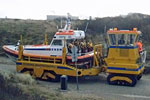
It contains a rescue boat of the Royal Netherlands Sea Rescue Institution (Dutch: Koninklijke Nederlandse Redding Maatschappij, abbreviated KNRM), a voluntary organization in the Netherlands tasked with saving lives at sea.
The lifeboat is mounted on a caterpillar trailer and towed to the beach by a similar vehicle. In the above picture it is just passing the Zeeduin.
Later in the day our investigative photo reporter found the tracks on the beach where the rescue boat had been launched. If you are interested to know how this is done you can watch it in the following video:
A video showing the launching of a KNRM Lifeboat
|
|
||||||||||||||||||||||||||||||||
|
|
||||||||||||||||||||||||||||||||
| Wednesday, January 21st –
Free day |
|||||||||||||||||||||||||||||||||
|
|
||||||||||||||||||||||||||||||||
|
|
||||||||||||||||||||||||||||||||
| Monday, January 26th –
Free day |
|||||||||||||||||||||||||||||||||
|
|
||||||||||||||||||||||||||||||||
| Thursday, January 29th –
Free day |
|||||||||||||||||||||||||||||||||
|
|
||||||||||||||||||||||||||||||||
|
|||||||||||||||||||||||||||||||||
|
|
||||||||||||||||||||||||||||||||
|
|
||||||||||||||||||||||||||||||||
| Wednesday, January 21st –
Free day |
|||||||||||||||||||||||||||||||||
|
|
||||||||||||||||||||||||||||||||
|
|
||||||||||||||||||||||||||||||||
| Monday, January 26th –
Free day |
|||||||||||||||||||||||||||||||||
|
|
||||||||||||||||||||||||||||||||
| Thursday, January 29th –
Free day |
|||||||||||||||||||||||||||||||||
|
|
||||||||||||||||||||||||||||||||
|
|||||||||||||||||||||||||||||||||
|
|
||||||||||||||||||||||||||||||||
|
|
||||||||||||||||||||||||||||||||
| Wednesday, January 21st –
Free day |
|||||||||||||||||||||||||||||||||
|
|
||||||||||||||||||||||||||||||||
|
|
||||||||||||||||||||||||||||||||
| Monday, January 26th –
Free day |
|||||||||||||||||||||||||||||||||
|
|
||||||||||||||||||||||||||||||||
| Thursday, January 29th –
Free day |
|||||||||||||||||||||||||||||||||
|
|
||||||||||||||||||||||||||||||||
|
|||||||||||||||||||||||||||||||||
Links
The games are being broadcast live on the official web site and on the chess server Playchess.com. If you are not a member you can download the free PGN reader ChessBase Light, which gives you immediate access. You can also use it to read, replay and analyse the PGN games. |
|