
ChessBase 17 - Mega package - Edition 2024
It is the program of choice for anyone who loves the game and wants to know more about it. Start your personal success story with ChessBase and enjoy the game even more.
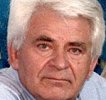
Boris Vasilievich Spassky (Russian: Бори́с Васи́льевич Спа́сский) was born on January 30, 1937 in Leningrad, Soviet Union, which is of course today known as Saint Petersburg. Boris learned the moves at the age of five, during a train ride in which citizens of Leningrad were being evacuated during the 1941-1944 siege of the city by the German Wehrmacht.
 Boris around 1948 |
Spassky was a classical child prodigy and gained nation-wide attention by beating the Soviet Champion Mikhail Botvinnik in a simultaneous exhibition in 1947, at the age of ten. At 16 he played successfully in a strong international tournament in Bucharest, Romania, and at 18 he won the World Junior Chess Championship in Antwerp, Belgium. The GM title was awarded to him that year, which was a record at the time. In 1956 he qualified for the Candidates Tournament for the first time, in Amsterdam, and finished in the middle of the ten-player world-class field. He was just 19 at the time.
Unfortunately the prodigy had a bad period and failed to qualify, as everyone had expected him to, in the world championship cycles from 1958 and 1961. He switched trainers, moving from the uncompromising attacking genius Alexander Tolush to the calm strategist Igor Bondarevsky. This proved to be fruitful and he won his first of two USSR Championships at Baku in 1961. He qualified for the Amsterdam Interzonal in 1964, and qualified for the Candidates' Matches the next year.
 Boris in 1960 |
Spassky became the ultimate all-rounder on the chess board, who could easily adapt his style to suit the needs of the moment. Against Keres he was a strategist, against Geller the wild attacker, and against Mikhail Tal he would steer the game into quiet waters where the great tactician could find no target to attack.
In 1966 Spassky played his first world championship match, against Tigran Petrosian. He lost it +3, =17, –4, but became the next challenger after beating Geller, Larsen and Korchnoi in Candidates matches. In 1969 he beat Petrosian by two points and became the tenth world champion in history. He lost the title to Bobby Fischer in the "Match of the Century" three years later.
The match against Fischer took place in Reykjavík, Iceland, at the height of the Cold War, and became a symbol of the political confrontation between the two superpowers. Before this match Fischer had never beaten Spassky, drawing twice and losing three times in their previous encounters. In Reykjavik, however, Fischer was able to triumph quite easily, in spite of losing the first game and forfeiting the second.

Spassky playing GM Jan Hein Donner at the Olympiad in Nice, 1974

The way we were – Ulf Andersson playing Anatoly Karpov in Nice 1974
After the Fischer match Spassky won a number of important events, including the 1973 Soviet championship, but was eliminated from the 1974 Candidates cycle by a new young star, Anatoly Karpov. Spassky again qualified for the Candidates in 1977, but was defeated by Viktor Korchnoi. Since then his career has been marked by a love for the finer sides of life that exceeded chess ambition. He settled in France with his third wife, became a French citizen and only played occasionally, relying on natural talent rather than intense preparation to achieve respectable scores.
|
In 1992 Spassky played the "Revenge Match of the 20th century" against Fischer in Sveti Stefan (Montenegro) and Belgrade, losing it with a score of +5, –10, =15, but winning a substantial amount of money in the process. In October 2006 Spassky suffered a minor stroke, from which he recovered well. |
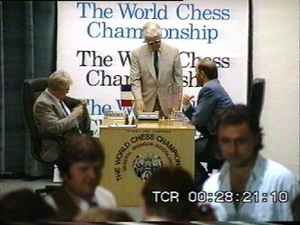 |
I first met Boris Spassky at a Munich tournament in 1979, where I was helping Dr Helmut Pfleger run experiments on the effects of certain drugs on chess players. Helmut measured the blood pressure of players before and during the games, and even took blood samples from the likes of Andersson and Spassky. Helmut Pfleger, who is a chess grandmaster, tried using a beta blocker on himself to see if it was advantageous not to have big spikes in his blood pressure (as measured with all the players at critical moments during the games). The answer was no, since Helmut lost "like a child" (his own words) to Spassky while playing under the influence of this medication. Apparently chess players need the full adrenalin rush to defend dangerous positions adequately.
Boris Vasilievich and I remained nodding acquaintances until on a fateful day in 1988 we were both stuck in a snowstorm in Toronto airport, on our way to the Candidates Tournament in St. John, New Brunswick, 1988. We were put up in the same hotel for the night and treated by the offending airline to a sumptuous dinner. This included copious amounts of good red wine, and after dinner Boris started to talk more freely than was hitherto his habit. In the four or five hours of conversation I learnt a substantial part of everything I know about the history of chess in the Botvinnik/Petrosian/Tal era. It was a fascinating encounter that I will never forget.
Since then Boris Vasilievich has settled in France, living the relaxed life of a retired gentleman grandmaster, occasionally foraying in the professional chess world to see if he still has The Touch. Once a year (at least) I hear from him by email. The request is always the same: can you fill my samovar with fresh tea, Frederic. The samovar is his computer, the fresh tea is the latest Mega Database. Recently he used this combination to beat Anatoly Karpov in a Generations Match. Yes, he still has it.
Frederic Friedel
Suddenly one realizes the eighth and tenth World Chess Champions, Mikhail Tal and Boris Spassky are less than three month apart in their birthdates: 9.11.1936 and 30.1.1937. It’s a time to start celebrating, and it is the chess club in his name and in his native town of Saint Petersburg that opened an anniversary row of chess events dedicated to the health of the King of Chess Boris Vassilyevich Spassky.
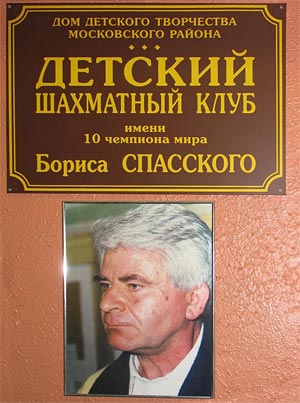
The Spassky Chess Club
The young masters (under 1990) rapid chess event was called Spassky Cup 2007 and held in the Spassky Chess Club, Basseynaya street 57, Saint Petersburg, Russia. Eight prodigy masters from Saint Petersburg and suburbs, including the rating favorite from Ukraine, IM Vladimir Onischuk, met in a round robin 12 min + 3 sec rapid chess games. The average rating was around 2400.
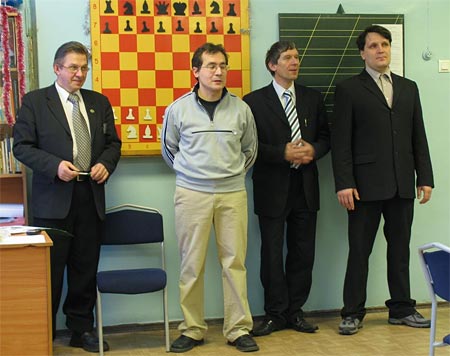
Opening ceremony: (from left) Chief Arbiter IA Viatcheslav Ivanov, the event organizer and Spassky Club head FM Kirill Annenkov, GM Sergey Ivanov, and GM Valerij Popov, the reigning Saint Petersburg champion.

First round pairing: WIM Valentina Golubenko 2261 vs IM Daniil Lintchevski 2449
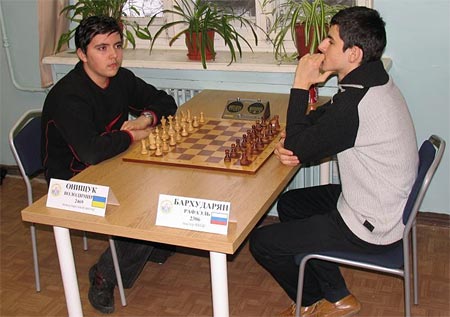
IM Vladimir Onischuk 2469 vs FM Rafael Barhudarian 2306
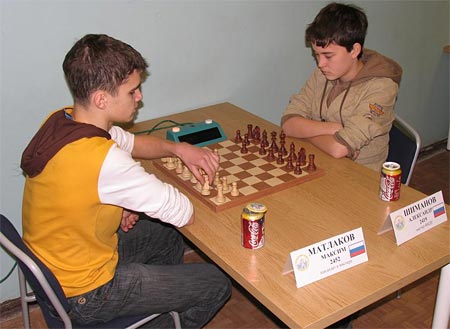
Live game Maxim Matlakov 2452 vs FM Aleksandr Shimanov 2419

Live transmission of the games by Boris Yeashan and his wife Olga
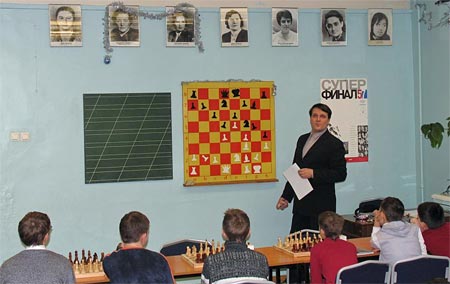
GM Valerij Popov offers move 13...g5!? in the round two game Lintchevski-Onischuk
In this tournament three players represented the Spassky Chess Club: FM Rafael Barhudarian (1991), WIM Valentina Golubenko (1990) and FM Aleksandr Volodin (1990). They are all students of chess coach Anastasia Golubenko. Valentina shared third place in European G10 and G12 (1999 and 2001, Greece) and shared 6th place in world’s B10 (1999, Spain). Aleksandr shared the 3rd place in the last European B16 (2006, Serbia and Montenegro).

Club members Valentina Golubenko and Aleksandr Volodin with the 10th World Chess Champion Boris Spassky, Moscow, June 2006. Photo: Kirill Annenkov

All participants received a special medal, of which only 12 were produced, dedicated to the 70th Anniversary of the tenth World Chess Champion Boris Spassky