
ChessBase 17 - Mega package - Edition 2024
It is the program of choice for anyone who loves the game and wants to know more about it. Start your personal success story with ChessBase and enjoy the game even more.
1956. The traditional Rosenwald Memorial Tournament is being held in New York. It is easily won by America's top grandmaster, Samuel Resevsky, two points ahead of his main rival, Artur Bisguier.

In the middle of the cross table of the event we find Donald Byrne and in the ninth spot we have a 13-year-old boy, one Bobby Fischer, who in July that year had won the US Junior Championship. Byrne himself had won the US Open Championship in 1953 and would go on to represent his country at three Olympiads. In 1956 he was one of the top-ten players in the US, and was also the brother of a well-known American grandmaster, Robert Byrne. On October 17th Byrne faced Fischer with the white pieces.

Oh the intensity! – Bobby Fischer in 1957
Byrne,Donald - Fischer,Robert James [D97]
Rosenwald New York, 1956 [Replay link at the end of the game]
1.Nf3 Nf6 2.c4 g6 3.Nc3 Bg7 4.d4 0-0 5.Bf4.Byrne is avoiding the King's Indian (with 5.e4), probably because he had heard that the lad sitting across from him was already one of the best KI players in the country. 5...d5 6.Qb3 dxc4 7.Qxc4 c6 8.e4 Nbd7 9.Rd1 Nb6 10.Qc5 Bg4 11.Bg5?!

11...Na4!! Reuben Fine awards this move three exclamation points (in "The World's Great Chess Games") and calls it "a brilliant reply". Flohr and Botvinnik in "64" called it "a shocking and stunning move." Fred Reinfeld called it "one of the most magnificent moves ever made on a chessboard," and recently GM Jon Rowson referred to it as "one of the single most powerful chess moves of all time." 12.Qa3. This is forced, probably the only playable move in the position. [12.Nxa4 The knight sacrifice cannot be accepted: 12...Nxe4 13.Qc1 (13.Qxe7 Qa5+ 14.b4 Qxa4 15.Qxe4 Rfe8 16.Be7 Bxf3 17.gxf3 Bf8 and Black is winning) 13...Qa5+ 14.Nc3 Bxf3 15.gxf3 Nxg5 and Black is clearly better (Shipov)] 12...Nxc3. A kibitzing GM here said that Black was simply lost in this position. 13.bxc3 Nxe4! Fine and Reinfeld give two exclamation marks. 14.Bxe7 Qb6!

15.Bc4 Taking is not advisable: 15.Bxf8 Bxf8 16.Qb3 Nxc3! "and Black is clearly better here" (Gligoric). 15...Nxc3! "Black comes up with one beautiful move after another" (I. Chernev). 16.Bc5. 16.Qxc3 Rfe8 17.Bxf7+ Kxf7 18.Ng5+ Kxe7 (Interesting that 18...Kg8?? would have given the opponent a spectacular finish: 19.Qc4+ Be6 20.Qxe6+ Kh8 21.Nf7+ Kg8 22.Nh6+ Kh8 23.Qg8+ Rxg8 24.Nf7# A smothered mate for White!) 19.0-0 Bxd1 20.Rxd1 Qb5 and Black is winning. 16...Rfe8+ 17.Kf1.

17...Be6!! The move that brought the 13-year-old instant world-wide fame. Reuben Fine gave it four exclamation marks ("An astounding reply ... which wins in all variations"), Flohr gave it three. "To have foreseen this spectacular queen sacrifice several moves in advance – as Fischer must have done – is extraordinary"; writes Graham Burgess in "The World's Greatest Chess Games". Our chess engine Fritz considers only this move from the first second onwards, giving it a +2 pawns score after a 16-ply search. Actually, everything else is bad for Black, for instance 17...Nb5? 18.Bxf7+! Kxf7 (18...Kh8 19.Bxb6 Nxa3 20.Bxe8+/-) 19.Qb3+ Be6 20.Ng5+ and White is winning. This confirms what Burgess says: Fischer had seen the queen sacrifice many moves in advance.
18.Bxb6 After this move Fritz immediately shows a 4.5-pawn advantage for Black, displaying the game continuation up to move 25 in it's main line. The alternative 18.Bxe6 is even worse: 18...Qb5+ 19.Kg1 Ne2+ 20.Kf1 Ng3+ 21.Kg1 Qf1+! 22.Rxf1 Ne2# and this time it is Black giving a smothered mate! It is extraordinary that the threat of smothered mate occurs for both side in a single game. But one must consider 18.Qxc3 Qxc5! 19.dxc5 Bxc3 20.Bxe6 Rxe6-+ but Black is a pawn up and easily winning.; The same applies to 18.Bd3 Nb5 with a clear advantage.
18...Bxc4+. Thus begins one of the greatest king hunts in chess history – and certainly one that gives enormous aesthetic pleasure. 19.Kg1. 19.Rd3 Bxd3+ 20.Kg1 Ne2+ 21.Kf1 Nf4+ 22.Kg1 axb6 and White loses everything. 19...Ne2+. The start of a windmill check series – the Germans call it "zwickmühle". 20.Kf1 Nxd4+. After removing the d-pawn the knight is protected on c3 by the Bg7 two moves later. 21.Kg1. 21.Rd3 axb6 22.Kg1 (after 22.Qc3 Nxf3 the queen falls) 22...Ne2+ 23.Kf1 Nf4 and White is completely lost. 21...Ne2+ 22.Kf1 Nc3+ 23.Kg1.

Black has at least a draw here, which may have been part of young Bobby's original calculations. But now he has more on his mind. 23...axb6 24.Qb4 Ra4! 25.Qxb6 Nxd1.

"Bobby has a Rook, two minor pieces, and a Pawn for the Queen – more than enough, materially speaking. Besides this, he has a mating attack against the White King. The rest is a mopping up operation, which he conducts with absolute precision" (Reuben Fine). Byrne is stubborn and plays on against the 13-year-old. 26.h3 Rxa2 27.Kh2 Nxf2. The advantage has grown to rook, two bishops and three pawns for the queen. 28.Re1 Rxe1 29.Qd8+ Bf8 30.Nxe1 Bd5. Instead of simply pushing and promoting a queenside pawn the young Fischer plays for mate. 31.Nf3 Ne4 32.Qb8 b5 33.h4 h5. Rawson notes that every black piece is defended, "a sure sign of good technique." 34.Ne5 Kg7 35.Kg1. To avoid the pin ...Bd6. But now it is a forced mate for Black.

35...Bc5+ 36.Kf1. 36.Kh2 Nd2 threatening 37...Nf1+ 38.Kh3 Bxg2# 37.Kh1 Ra1+ 38.Kh2 Nf1+ 39.Kh3 Ra2 and mate to follow. 36...Ng3+ 37.Ke1 Bb4+. There were shorter mates: 37...Re2+ 38.Kd1 Bb3+ 39.Kc1 Ba3+ 40.Kb1 Re1#; or even 37...Bb3 38.Qh8+ Kxh8 39.Nxf7+ Kg7 40.Nd6 Re2#. 38.Kd1 Bb3+ 39.Kc1 Ne2+ 40.Kb1 Nc3+ 41.Kc1 Rc2#

Bobby went for the elegant, systematic mate, which Byrne very gamely allowed him to deliver. 0-1.
Click to replay the game on our JavaScript board
Note that you can click the notation to follow the moves

The original scoresheet from 1956 with Bobby's handwriting
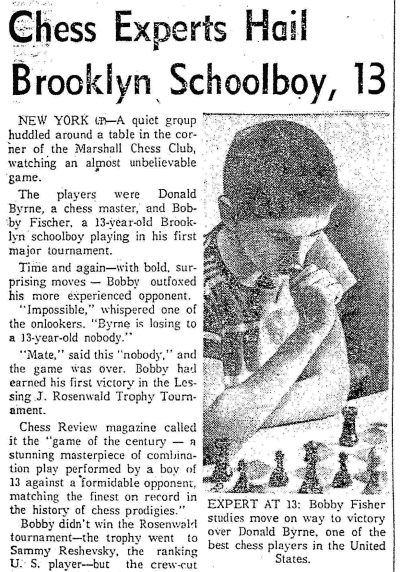
Above is the only picture we know showing Fischer during the Game of the Century. Incredibly it was taken while he was pondering the position just before the queen sacrifice. The picture appeared on page 11 of the Lima News, Feb. 12, 1957, and also appeared in the Hammond Times of Feb. 24, 1957 [scan provided by Lawrence T. Totaro].
Hans Kmoch, a famous chess writer and preeminent chess journalists at the time, labeled this the "Game of the Century" in Chess Review. The name stuck. Samuel Reshevsky called it "a very profound and marvelous conception"; Mikhail Botvinnik said: "We will have to start keeping an eye on this boy." Fred Reinfeld said it was "one of the most brilliant, pretty, and one of the most magnificent games of chess ever played." The game has been quoted and discussed in countless chess books and collections, but interestingly it is not to be found in Bobby Fischer's "My 60 Memorable Games."

13-year-old Bobby Fischer giving a simul in 1956

Above we see Bobby Fischer playing at the Manhattan Chess Club in 1957. Aben Rudy of Scottsdale, Arizona, helped us identify some of the people in the picture: Bobby's opponent is his friend James Gore, and the gentleman to Bobby's right is Dr. Daniel Benninson, later to become head of Argentina's Atomic Energy Commission. At the time, Dr. Benninson -- a very active member of the Manhattan -- was a member of the Argentine delegation of the United Nations in New York.
Frederic Friedel
In our 2001 Christmas Puzzle we had the following task: Here is a very famous game, or rather a small extract of it. The replay board only shows the moves of the black knight in the course of the game. This knight was absolutely decisive. It tore into the white position, creating mayhem and winning the encounter for Black. Your task is to identify the game and the players. It is one of the best-known games in chess history. Click here to replay the knight moves.
Video of the the young Bobby Fischer gives a simul around the time of his game against Byrne
Time Magazine article from March 24, 1958: Master Bobby
Quote: Though he celebrated his 15th birthday only last week, [Bobby Fischer] already shows all the marks of the great grand masters of one of the oldest, most intricate games known to man. A floppy, abrupt young gangle-shanks, he stumbles through the physical world of school and subways and summer vacations in a tangle of arms and legs not quite under control. But in the neatly ordered empire of the chessboard, he moves with vast precision. Swiftly he picks his way among the possibilities; haughtily he sidesteps the traps. Experts compare his aggressive, scientific style to that of Russia's famed Alekhine, his flair for combinations to the touch of the U.S. master, Morphy. He eclipsed such comparative greybeards as Samuel Reshevsky, 46, and Arthur Bisguier, 28, to win the U.S. title. The Fédération Internationale des Echecs made a special gesture of naming him an International Master of Chess. Said Bobby last week in his adolescent whine: "They shoulda made me a Grand Master." Bobby is credited by Annotator Kmoch with "the Game of the Century" – one that chess buffs retrace in slack-jawed admiration. It marked the boy's upset victory over Donald Byrne in last year's Lessing J. Rosenwald tournament...
A.J. Goldsby: The Game of the Century with a large collection of analysis and quotes.