
ChessBase 17 - Mega package - Edition 2024
It is the program of choice for anyone who loves the game and wants to know more about it. Start your personal success story with ChessBase and enjoy the game even more.

The following are excerpts from the Sunday Telegraph column by Nigel Short. The link at the bottom leads you to the full story (with an annotated game). Note that you have to register, free of charge, to read the columns. This entails giving an email address and a password for future logins.
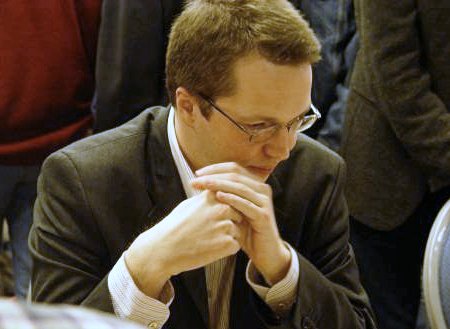
Nigel Short, Telegraph chess columnist
Filed: 29/08/2004
If chess is a vast jungle – deep, relatively unexplored and slow to yield its myriad secrets – computers are the chainsaws in a giant environmentally insensitive logging company. If our beloved game is not to be reduced to a glorified noughts and crosses – an arid computational desert – then, like a beautiful and intelligent woman, it must retain an element of mystery.
If I sound uncharacteristically sentimental, it is probably because my wife and I celebrated our 17th wedding anniversary this week and thus, for once, my thoughts are jolted out of their quotidian rut onto matters of the emotions. A little romance does not come amiss in either chess or love, or so I try to remind myself from time to time.
In my opinion perhaps the most romantic of all openings is the King's Gambit (1. e4 e5 2. f4!). A few years ago I sat in a bar with Vladimir Kramnik discussing theory. At that time the future World Champion was contemplating a switch to King's Pawn openings and he wanted to bounce his preliminary ideas off me. He opined that the Evans' Gambit (1. e4 e5 2. Nf3 Nc6 3. Bc4 Bc5 4. b4!) was very logical: White sacrifices a fairly unimportant wing pawn to open lines and accelerate his development. This was not necessarily to say that it was Vlad's preferred method of starting the game, but at least he could understand the rationale behind it. In contrast, the King's Gambit, however, was for him totally incomprehensible: it loses a pawn and weakens the kingside, for all he could see.
Of course Vlad was absolutely right; my scientific deductive side had to agree – the King's Gambit has had a somewhat dodgy reputation ever since it was first mentioned in Lucena's manuscript of 1497. And yet my irrational mystical side revolted and still revolts against so cold and sober a judgement. There is something inspiring about voyaging into storm-tossed seas.
Over the years the most successful practitioner of the King's Gambit has been Boris Spassky. His record of 16 victories and no defeats (with some draws) is unsurpassed. His victims include two of the most illustrious names in chess history – Bobby Fischer and Anatoly Karpov – and his famous brilliancy against Bronstein was used as the opening scene of the Bond movie From Russia with Love.
The movie Nigel mentions, From Russia with Love, was produced in 1963. One of the villains is Kronsteen, played by Vladek Sheybal, master plotter for the terror organisation SPECTRE. Kronsteen is also a world-class chess player who, when asked if his plan would be successful, replies: "It will be. I've anticipated every possible variation of countermove." And Bond's colleague, the Turkish operative Kerim Bey, says of him: "These Russians are great chess players. When they wish to execute a plot, they execute it brilliantly. The game is planned minutely, the gambits of the enemy are provided for."
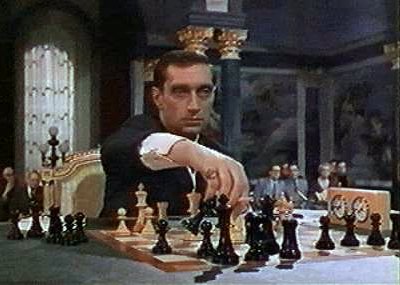
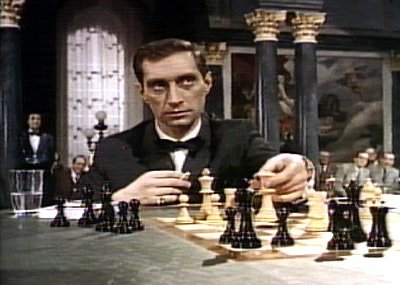
In the famous chess scene at the beginning of the movie we see Kronsteen playing the Canadian McAdams in an "International Grandmaster Championship". The score is 11½–11½. The position on the board is the following:
Kronsteen – McAdams, From Russia with Love, 1963

Here Kronsteen gives his opponent a long glare and then plays 1.Nxe5+ (as you can see in the picture above). He ominously says "check" while the move is displayed for the audience on a large demonstration board. McAdams nervously plays 1...Kh7, after which Kronsteen smiles and plays 2.Qe4+.
McAdams is horrified and knocks over his king as a sign of resignation, muttering "Congratulations sir, that was a brilliant coup." The audience bursts into applause as Kronsteen leaves the room to get on with his evil plottings.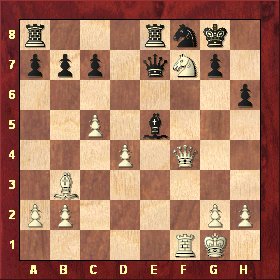 "). And an article entitled James Bond and Chess gives the following fascinating information, which we should have included:
The position on a wallboard in the movie is based on an intruiging King's Gambit won by Boris Spassky against David Bronstein at the USSR Championship in 1960. Here it takes place at the Venice International Tournament where Kronsteen ignores a courier's sealed message ordering him to stop play on the spot. He knows he risks his life if he fails to obey, but how many players can abandon a sure win? At his own peril Kronsteen waits three more minutes to accept his opponent's resignation; but later he must explain to his superior why he did not obey at once. In the book his excuse is accepted reluctanctly:
"To the public, Comrade General, I am a professional chess player. If, with only three minutes to go, I had received a message that my wife was being murdered outside the door of the tournament hall, I would not have raised a finger to save her. My public know that. They are dedicated to the game as myself. Tonight, if I had resigned the game and had come immediately upon receipt of that message, 5000 people would have known that it could only be on the orders of such a department as this. There would have been a storm of gossip. My future comings and goings would have been watched for clues. It would have been the end of my cover. In the interests of State Security, I waited three minutes before obeying the order. Even so, my hurried departure will be the subject of much comment."
Finally, for those of you who can't get enough of the subject, there's a deep analysis, in German, of James Bond's psychological relationship to chess in this Meta-Chess site.