
ChessBase 17 - Mega package - Edition 2024
It is the program of choice for anyone who loves the game and wants to know more about it. Start your personal success story with ChessBase and enjoy the game even more.
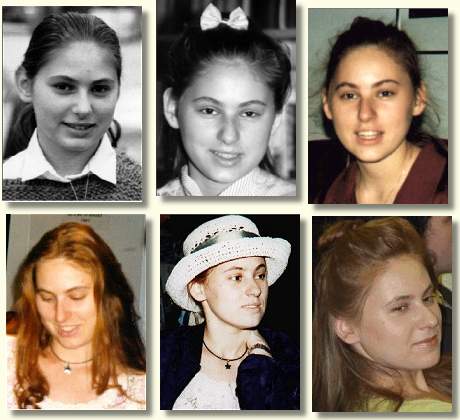
Pictures of Judit taken from the ChessBase Players Encyclopedia. They are dated 1988, 1989, 1993, 1996 (it was a phase), 1996 (the famous hat picture) and 2002.
Judit was born on July 23, 1976 in Budapest, Hungary. Her father László was a pedagogue, specialised in chess. He announced, before his children were born, that he intended to make them world-class players in chess.
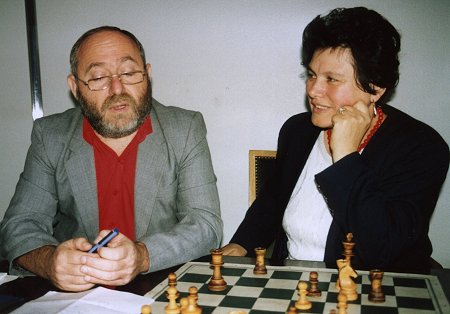
László and Klara Polgar (in 1993)
To his initial chagrin Lászlo's wife Klara bore him three girls. But the chess instructor proceeded undaunted with his plan and produced a four-time world champion (oldest daughter Susan), one strong GM with some of the highest tournament performances in chess (Sophia) and the strongest female player in the history of the game: the youngest daughter Judit.
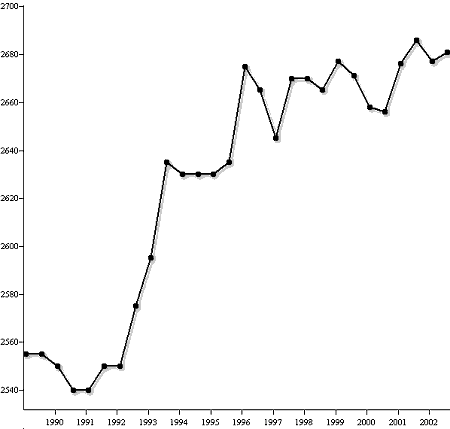
Above is Judit's Elo development since 1989, as documented by the ChessBase Mega Database. Here are some interesting statistics on Judit Polgar (compiled by Mig Greengard):
|
Current FIDE rating |
2718 |
| Current world ranking |
#11 |
| Number of pages found for “Judit Polgar” in the Google search engine |
6,510 |
| Number of pages found for “Peter Leko” |
6,200 |
| Judit’s score in the 1988 Women’s Olympiad in Thessaloniki at the age of 12 |
12.5/13 |
| Her score in the 2000 (“Men’s”) Olympiad in Istanbul |
10/13 (+8 –1 =4) |
| Became a Grandmaster in 1991 at the age of |
15 years, 5 months |
| Person whose record Judit broke to become the world youngest Grandmaster ever |
Bobby Fischer |
| Number of Judit Polgar games in the 2003 edition of the ChessBase database |
1,296 |
| Number of Bobby Fischer games |
952 |
| Number of years Judit has been the top-rated woman in the world |
13.5 |
| Number of rating points between her and the current number two rated woman |
215 |
| Number of points between the number two woman and number one hundred |
101 |
I first met the Polgar family twenty years ago, in Budapest in 1983. Acutally I went over to their flat to talk to Zsuzsa, who was the 14-year-old rising star of women's chess. I was introduced to László Polgar, the father who had initiated the chess boom in the family; his wife Klara, who speaks many languages (including all of those I speak); and two little girls, the younger sisters of Zsuzsa (Susan) Polgar.
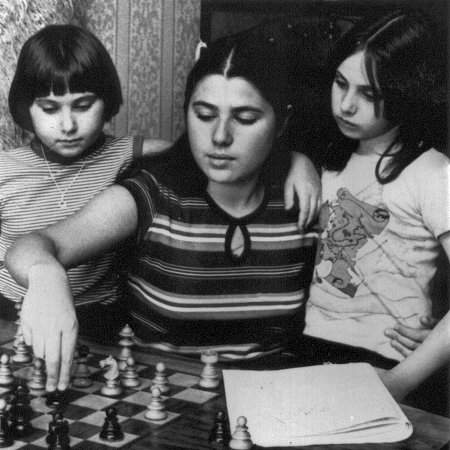
Susan Polgar with her little sisters, who are obviously interested in chess
It was during the World Microcomputer Chess Championship, and I spoke at length with Susan. I asked her about her cute little sisters. "Do they also play chess?" She smiled and answered simply "Sure." Later I invited Susan to play a game against one of the strongest chess programs in the world at the time. "Let my sisters play," she said.
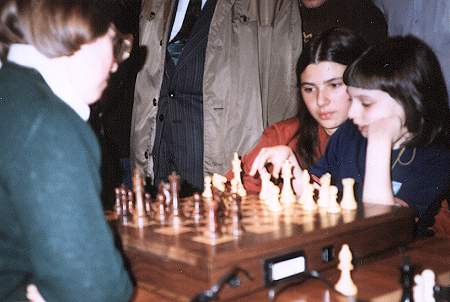
And play they did, against the Fidelity computer that went on to win the Word Micro. I was called away before the first game ended. After two games I returned and asked Fidelity programmer Kathe Spracklen (operating the program in the picture above), tongue-in-cheek, whether the girls had beaten the computer. "Of course not," she replied, "they did not beat it. How could you imagine that? They are just babies. No, they did not beat it, they murdered it, they tore it to little pieces, they chewed it up and spat out the pieces, they massacred the thing!" Never before or since have I seen a chess programmer so flushed with pleasure at the defeat of his or her program.
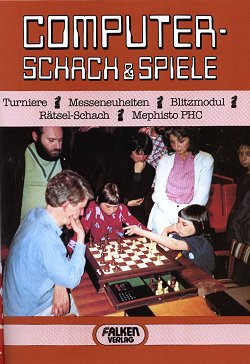 |
The picture on the left appeared on the cover of a German computer chess magazine. It shows Sophie Polgar playing the runner-up Mephisto computer, with Judit and her father (standing on the left) watching. "So they are very strong players?" I said to Susan, after seeing them defeat the world's best computers. "Yes, especially the little one," she answered. "Watch out for her, she will be the strongest of the three of us!" |
In the following years I was in Budapest a number of times, almost always staying in the Polgars' flat. I slowly began to see that Judy was really something special. I remember late one night when Susan was analysing with a trainer, a strong IM. They reached an endgame and could not figure out how to play it. "There is some trick here," said the IM. So they woke up Judit and carried the girl into the training room. Judy, still half asleep, showed them the win and was put back into her bed.
A few years later we went to see FIDE president Florencio Campomanes in his hotel suite in Budapest. The Polgars were having a lot of trouble with the Hungarian Chess Federation, so that the meeting has somewhat touchy overtones. To break the ice Campo suggested some blitz games, where he has a fair reputation.
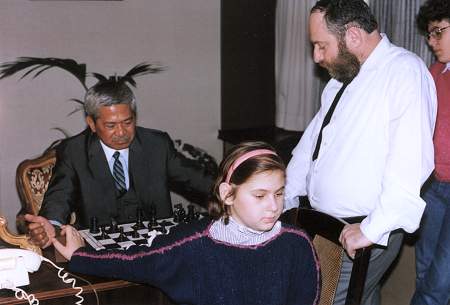
László Polgar offere him blindfold games against his youngest daughter. Judit sat with her back to the board, streching her hand behind her to operate the clock. László dictated Campo's moves to Judit, who at the time spoke only Hungarian. They played two or three games in this fashion. If you want to know the result, look carefully at Campo's face and see Kathe Spraklen's memorable quote above.
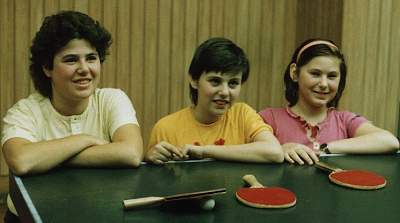
Ping-Pong players Susan, Sophia and Judit Polgar
The three Polgar girls were also keen table tennis players. The first time I played against Judit I managed to win. The look on her face was unequivocal: I'm gonna come back and I'm gonna kill you, buddy. She started taking lessons from a professional and the next time I faced her she pulled out a devastating top spin. The result: once again cf. Kathy Spracklen above.
For a long time I was only able to communicate with Judy with tickles and shoves. A common dialog during walks along the Danube River in Budapest went as follows:
Susan: "Stop it, Judit, behave yourself!"
Judit: "But he started it! I'm just fighting back."
All of this in Hungarian. Then one day, in May 1989, the four Polgar women (Klara and her daughters) visited my home south of Hamburg. And Judit beamed at me: "I can speak English now, Frederic." She spoke an unambitious but expressive English. Since then we have been real friends.
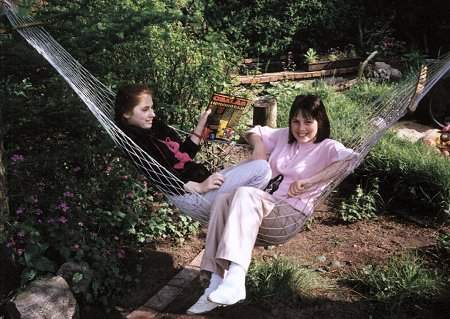
It was a lovely summer in 1989, and the two younger sisters Judit and Sophia spent much of their visit in a hammock in the garden, reading Hungarian teeny magazines.
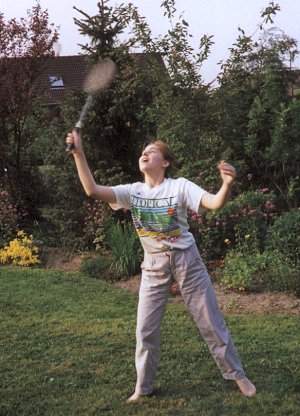
Of course Judit was equally ambitious in garden badminton.
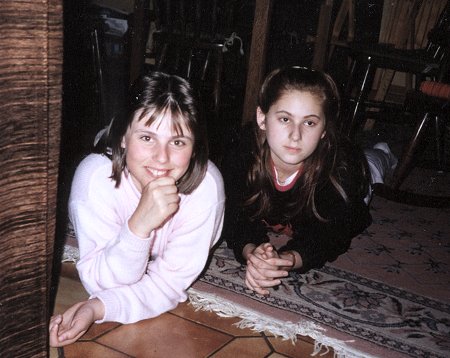
Sophie and Judy in the typical position for watching TV
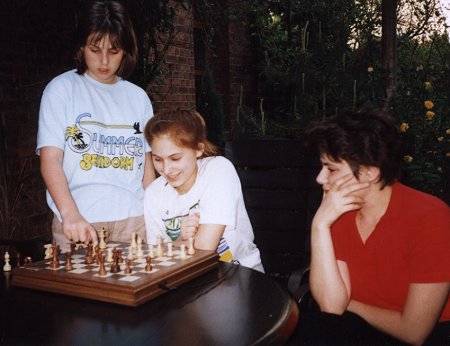
Sometimes the three Polgars experimented with my chess computers, which had of course in the meantime become very much stronger.
There is one story that must be told. At the time of that visit my son Martin had a white rat, appropriately named Basil. It was a gentle creature, but all the Polgars were terrified of it. Except Judit, who would take Basil up and try to force her sisters and her mother to pet it.
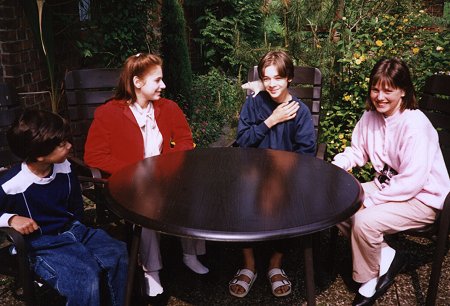
Judit and Sophia on the garden terrace, with Martin and Basil the rat
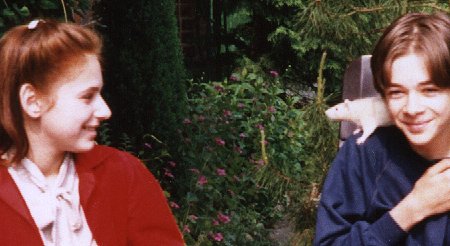
If you look carefully you can see the obvious affection between Judy and Basil
Well, Basil was used to certain rituals. Every morning when Martin came down for breakfast he would give Basil a morsel of rat food. You know, a piece of leftover pizza, salami or a Dorito chip. Basil would eagerly wait for this treat, pacing around in its cage in anticipation. The animal had, however, one concern in life: that one day its owner would stick the food into the cage and then suddenly change his mind and pull it out again. So when it appeared between the bars Basil would grab it with both front legs and teeth, and actually lie on its back until Martin moved away and the coast was clear to roll over and enjoy the treat.
One morning it was Judit who came down first. She went over to Basil and, with the words "Hello little ratty", she stuck her finger into the cage. The rest is too grusome to narrate. Just that Judy put a plaster over the wound and was convinced that she was going to die. But she never told anyone what had happened, only the next day, when it became obvious that she would live and the bite was not so bad after all.
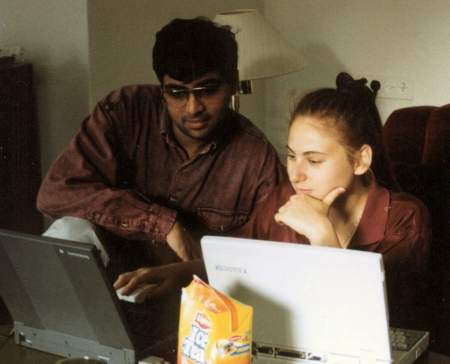
In closing here's an interesting picture from 1993 – Judit playing against an early version of Fritz on a notebook, with some Indian dude watching. Judit managed to lose one of the games, upon which the Indian GM grabbed me and physically pinned me to the floor. He kept shouting "Quick, Judit, press Ctrl-N", while I shouted "Press Ctrl-S, press Ctrl-S!". Unfortunately she pressed Ctrl-N. :-(
Oh, yes, ten years later the two are playing a rapid chess match against each other.
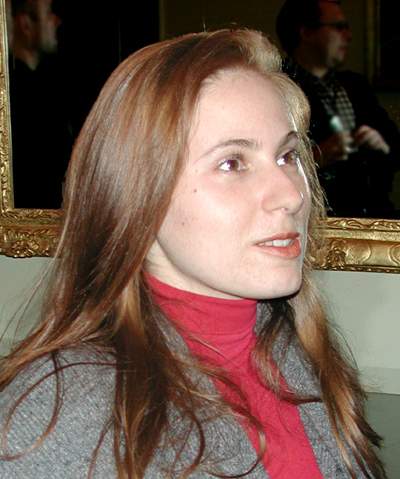
Judit today, at the top of the chess world.